How Long Can You Survive Without Water? (Scientific Breakdown)

How long can the human body survive without water? Learn the real survival timeline, dehydration stages, and critical emergency preparedness strategies.

EMERGENCY PREPAREDNESS

Global Survivalist Team

2/25/20264 min read

Introduction

Water is not just important for survival — it is survival.

You can survive weeks without food.
You can survive days without sleep.
But without water, your body begins shutting down far faster than most people realize.

In emergency preparedness planning, one of the most misunderstood survival questions is:

How long can you actually survive without water?

This scientific breakdown explains exactly what happens to the human body during dehydration, how environmental conditions change survival time, and what you must prepare for in real-world grid-down scenarios.

The Scientific “3-Day Rule” Explained

You may have heard the survival rule of threes:

  • 3 minutes without air

  • 3 hours in extreme exposure

  • 3 days without water

  • 3 weeks without food

The “3 days without water” rule is a general guideline — not an exact limit.

Actual survival time depends on:

  • Temperature

  • Humidity

  • Physical exertion

  • Body composition

  • Age & health

  • Access to shade

  • Stress level

For some, survival may drop below 24 hours. For others in mild conditions, it may extend slightly beyond 3 days.

But physiology sets hard limits.

What Happens to Your Body Without Water?

The human body is approximately 60% water.

Water regulates:

  • Blood circulation

  • Temperature control

  • Oxygen delivery

  • Nutrient transport

  • Waste removal

  • Brain function

  • Muscle performance

Without hydration, your body begins conserving fluid immediately.

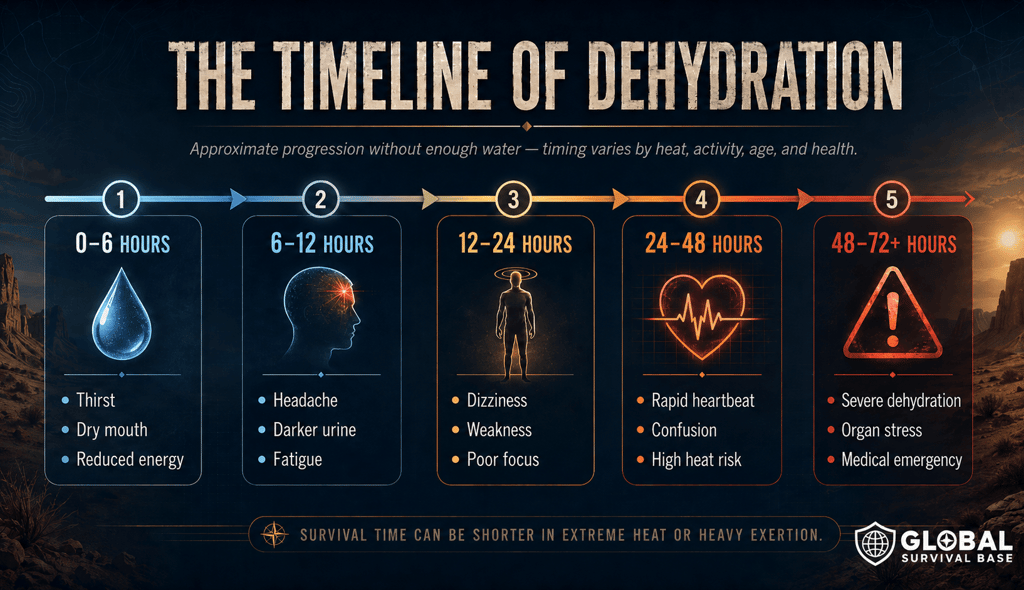
Let’s break down the timeline.

0–12 Hours: Early Dehydration

Symptoms:

  • Thirst

  • Dry mouth

  • Darker urine

  • Mild fatigue

  • Slight headache

At this stage:

  • Kidneys reduce urine output

  • Heart rate slightly increases

  • Blood volume begins decreasing

In hot climates, this stage accelerates dramatically.

12–24 Hours: Moderate Dehydration

Symptoms escalate:

  • Dizziness

  • Muscle cramps

  • Rapid heartbeat

  • Reduced sweating

  • Irritability

  • Confusion beginning

Blood thickens slightly.
Electrolytes begin shifting.

In hot environments, heat exhaustion risk becomes severe.

24–48 Hours: Severe Dehydration

Now survival stability becomes fragile.

Symptoms:

  • Extreme weakness

  • Disorientation

  • Little to no urination

  • Low blood pressure

  • Rapid breathing

  • Sunken eyes

At this stage:

  • Sodium concentration rises

  • Nerve signaling becomes unstable

  • Decision-making deteriorates

In survival situations, mental decline is often more dangerous than physical weakness.

48–72 Hours: Critical Window

After approximately 72 hours:

  • Organ stress becomes critical

  • Kidney failure risk rises

  • Hallucinations may occur

  • Loss of consciousness possible

  • Cardiac arrhythmia risk increases

Death can occur shortly after — especially in extreme heat.

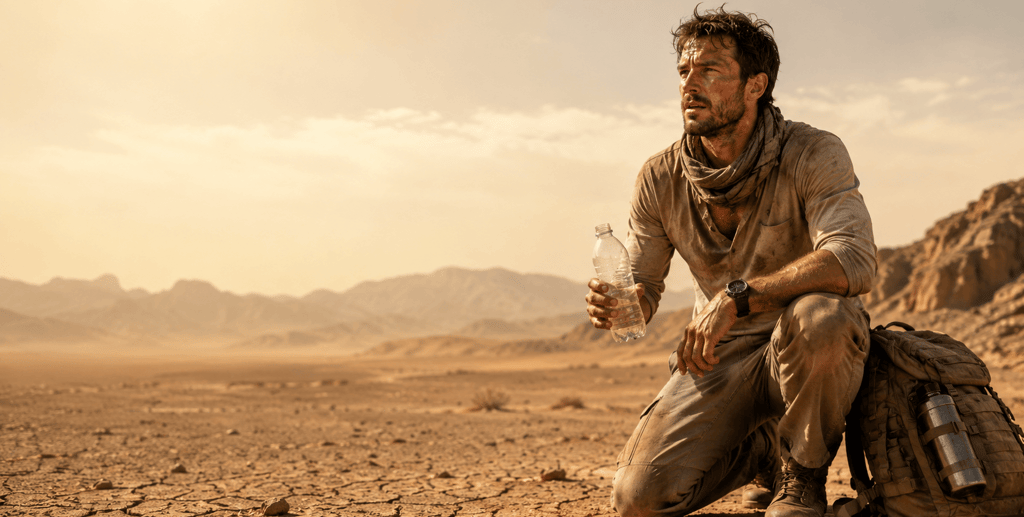
In desert conditions above 40°C (104°F), survival can fall below 24–48 hours

Environmental Factors That Change Survival Time

1. Temperature

Hot desert: survival dramatically shortened.
Cool shade: survival slightly extended.

2. Activity Level

Walking under sun: up to 1 liter sweat per hour.
Running: 2 liters per hour possible.

High exertion accelerates dehydration rapidly.

3. Humidity

Dry air increases respiratory water loss.

4. Age & Health

  • Children dehydrate faster

  • Elderly dehydrate faster

  • Ill individuals dehydrate faster

Organ Failure Mechanism

Severe dehydration causes:

  1. Blood thickening

  2. Reduced circulation

  3. Kidney filtration failure

  4. Toxin buildup

  5. Electrolyte imbalance

  6. Heart rhythm instability

Kidneys are typically first to fail in fatal dehydration cases.

Urban Blackout Scenario: Why This Matters

In a grid-down scenario:

  • Water pumping stations may fail

  • High-rise buildings lose pressure first

  • Treatment plants shut down

  • Bottled water disappears from stores within hours

In urban environments, water systems rely entirely on electricity.

If the grid collapses, stored water determines your stability.

How Much Water Do You Actually Need?

Minimum survival intake (sedentary, mild climate):

1.5–2 liters/day (absolute survival minimum)

Preparedness recommendation:

1 gallon (3.7 liters) per person per day

This includes:

  • Drinking

  • Minimal hygiene

  • Basic food preparation

For a 72-hour emergency:

Minimum 3 gallons per person.

Better:
7-day supply.

Ideal:
30-day supply if space allows.

Water Conservation Strategies

If you cannot access water:

  • Stay in shade

  • Avoid unnecessary movement

  • Cover skin from sun

  • Minimize sweating

  • Breathe through nose

  • Stay calm

Conserving water can extend survival significantly.

Emergency Water Purification

If stored water runs out:

Safe methods include:

  • Boiling (rolling boil 1 minute minimum)

  • Water purification tablets

  • Portable filter systems

  • Gravity filtration

  • Proper bleach dilution (emergency only)

Never drink untreated surface water.

Diarrhea accelerates dehydration and can become fatal.

Psychological Effects of Dehydration

As dehydration progresses:

  • Anxiety rises

  • Irrational thinking begins

  • Aggression may increase

  • Poor judgment becomes dangerous

The brain is 75% water.

Cognitive decline is often the first survival failure.

The Realistic Survival Limit

In mild climate:
3 days is realistic upper limit.

In hot desert:
1–2 days.

Under extreme heat and exertion:
Less than 24 hours possible.

Rare survival beyond 4–5 days requires:

  • Cool environment

  • Total inactivity

  • Shade

  • Minimal sweating

Final Survival Takeaway

Water is the foundation of preparedness.

You can survive weeks without food.
You cannot survive long without water.

If:

  • Power fails

  • Supply chains collapse

  • Civil unrest disrupts utilities

Stored water becomes your first line of stability.

Preparedness is not fear.

It is calculated resilience.

Immediate Action Plan

Today:

  1. Calculate household water needs.

  2. Store minimum 3-day supply.

  3. Acquire one purification method.

  4. Learn dehydration warning signs.

  5. Train water discipline mindset.

Water security equals survival security.

Start Your Preparedness Journey

Download the
Free Emergency Preparedness Checklist and begin building your survival readiness today.


hero image How to Survive Without Electricity (Family Step-by-Step Survival Guide)

Related Articles

Download Free Printable Preparedness Checklists Series :

👉Download Free Checklist

Designed to help individuals and families prepare with structure, clarity, and confidence.

If you haven’t built your full survival foundation yet,

begin with our complete preparedness guide