How to Survive a 72-Hour Power Grid Failure

Learn how to survive a 72-hour power grid failure with practical steps for water storage, food rationing, security, and blackout survival strategy.

SURVIVAL SKILLS

Global Survivalist Team

2/24/20264 min read

A power outage lasting a few hours is an inconvenience.

A 72-hour power grid failure is a system stress test.

There is a massive difference between losing electricity for an evening and experiencing a multi-day grid collapse. When the power goes out for three days, it doesn’t just affect lighting. It affects water systems, fuel access, food storage, communication networks, banking transactions, traffic control, and emergency response capacity.

Electricity is not just convenience. It is infrastructure.

When the grid fails for 72 hours, modern life slows down fast. The goal is not panic. The goal is controlled adaptation.

Preparedness turns blackout into manageable disruption.

This guide will walk you through a simple, practical, phase-based survival plan you can apply immediately.

Understanding What Really Happens During a 72-Hour Grid Failure

Before we discuss action steps, you must understand the chain reaction.

Within minutes:
• Traffic lights fail
• Elevators stop
• Gas stations cannot pump fuel
• ATMs go offline
• Cellular networks begin congestion

Within hours:
• Refrigerators begin warming
• Water pressure may decline (electric pumps fail)
• Retail stores close
• Online payment systems fail

Within 24–48 hours:
• Food spoilage increases
• Fuel shortages begin
• Public frustration rises
• Law enforcement resources stretch thin

Within 72 hours:
• Anxiety spreads
• Supply chains freeze
• Opportunistic crime risk increases

Your survival strategy must evolve with each phase.

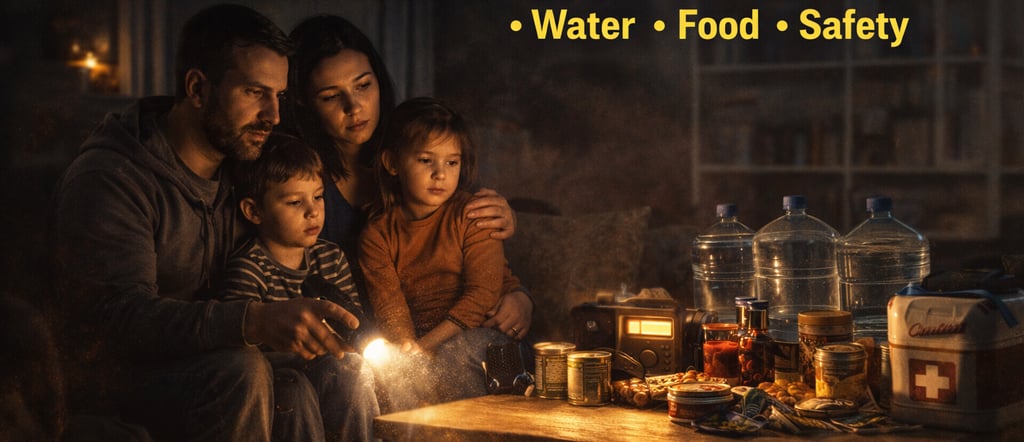
Created by GlobalSurvivalBase.com, this 72-hour power grid failure infographic delivers a practical family blackout preparedness blueprint, outlining what to do, how to prepare, and clearly defined emergency roles for every household member.

Phase 1: The First 12 Hours (Stabilize and Secure)

The first 12 hours determine whether you stay ahead or fall behind.

Most people assume power will return quickly. That assumption causes delay. Delay reduces options.

1. Fill All Available Containers with Water

Even if water is still running, fill:

• Bathtubs
• Buckets
• Bottles
• Pots
• Any clean container

Municipal water systems depend on electric pumps. If backup generators fail or fuel runs out, pressure drops.

Water is priority number one.

You need at minimum:
1 gallon per person per day (drinking + minimal hygiene).

For 72 hours, that means 3 gallons per person minimum.

More is better.

2. Preserve Refrigerator Cold

Cold equals time.

Immediately:
• Lower fridge/freezer temperature setting
• Stop unnecessary opening
• Consolidate items tightly (full spaces stay cold longer)

A closed refrigerator keeps food safe for about 4 hours.
A full freezer can stay frozen 24–48 hours if unopened.

Treat every opening as lost insulation.

3. Switch to Battery Lighting Only

Do not wait until night to test your lighting.

Prepare:
• Flashlights
• Headlamps
• Battery lanterns

Avoid candles (fire risk increases during outages).

Conserve power immediately. Do not use lighting casually. Establish a central light zone at night instead of lighting entire rooms.

4. Monitor Local Updates (Radio > Phone)

Cell networks overload quickly.

A battery-powered or hand-crank radio gives you:
• Official updates
• Restoration timelines
• Safety advisories

Phones are tools. Radios are infrastructure.

Use phones sparingly. Lower screen brightness. Enable battery saver mode.

Phase 2: 24–48 Hours (Adapt and Conserve)

If power is not restored within 24 hours, shift your mindset.

This is no longer inconvenience. This is resource management.

1. Ration Water Strictly

Rule:
1 gallon per person per day.

Breakdown:
• 0.5 gallon drinking
• 0.5 gallon minimal cooking + hygiene

Avoid unnecessary washing. Use wipes. Reuse gray water for toilet flushing if needed.

Water discipline prevents desperation.

2. Shift to Shelf-Stable Food

Stop opening the refrigerator unless absolutely necessary.

Begin consuming:
• Canned goods
• Dry goods
• Protein bars
• Rice
• Oats
• Peanut butter
• Ready-to-eat meals

Eat refrigerated items first before spoilage.

Avoid heavy cooking that wastes fuel.

Caloric efficiency matters.

3. Maintain Low Visibility at Night

In extended outages, neighborhoods go dark.

If your home is brightly lit while others are not, you stand out.

Use minimal lighting. Close curtains.

Light discipline reduces attention.

Remember: visibility equals vulnerability.

4. Avoid Unnecessary Travel

Gas stations may not function. Traffic lights may be down. Law enforcement may prioritize emergencies only.

Stay home unless:
• Medical necessity
• Immediate evacuation trigger
• Essential supply acquisition

Movement increases exposure.

5. Secure Perimeter Awareness

You do not need to become aggressive. You need to become observant.

At night:
• Lock doors
• Lock windows
• Reduce noise
• Avoid broadcasting routine

Security begins with awareness, not confrontation.

Phase 3: 48–72 Hours (Stability and Contingency)

By this stage, uncertainty increases.

You must evaluate:

Is this temporary?
Is this expanding?
Is restoration credible?

This phase requires mental discipline.

1. Establish a Security Routine

Routine creates control.

Rotate:
• Night checks
• Sound awareness
• Neighborhood observation

Avoid paranoia. Maintain calm.

Visible panic attracts attention.

2. Reassess Evacuation Triggers

Pre-define triggers such as:

• Water supply failure
• Escalating violence nearby
• Medical emergency
• Official evacuation order

Do not evacuate emotionally. Evacuate based on criteria.

Preparation prevents rushed decisions.

3. Conserve Energy (Physical and Mental)

Fatigue creates mistakes.

Sleep in shifts if necessary.
Avoid excessive media consumption.
Control stress conversations.

Energy is a resource.

So is morale.

4. Stay Informed Without Overloading

Check updates periodically, not constantly.

Misinformation spreads rapidly during outages.

Verify information through:
• Official emergency broadcasts
• Multiple sources

Do not act on rumors.

Essential Supplies for a 72-Hour Grid Failure

Minimum readiness kit:

Water:
• 3 gallons per person
• Water purification tablets
• Portable filter

Food:
• 72-hour non-perishable supply
• Manual can opener

Lighting:
• Flashlights
• Headlamps
• Spare batteries

Communication:
• Battery radio
• Power bank

Medical:
• First aid kit
• Necessary prescriptions

Sanitation:
• Wipes
• Trash bags
• Basic hygiene supplies

Security:
• Reinforced locks
• Motion sensor lights (solar)

Preparedness is layered protection.

Common Mistakes During Extended Power Failures

  1. Assuming restoration is immediate

  2. Consuming resources too fast

  3. Broadcasting preparedness

  4. Panic buying late

  5. Ignoring water storage

  6. Traveling unnecessarily

  7. Draining phone batteries early

Discipline beats panic every time.

The Psychological Component

A 72-hour outage is as much mental as physical.

Expect:
• Frustration
• Restlessness
• Anxiety

Combat this by:

• Maintaining routine
• Assigning tasks
• Staying physically active
• Keeping communication calm

Children and elderly individuals require reassurance.

Leadership within your household matters.

Calm spreads. Panic spreads faster.

Choose what you transmit.

Final Thought: Preparedness Changes Everything

A 72-hour power grid failure feels catastrophic only if you are unprepared.

With planning, it becomes manageable.

You do not need extreme survival gear.

You need:

• Water discipline
• Energy conservation
• Information awareness
• Emotional control
• Low visibility

Preparedness converts chaos into structure.

When the lights go out, your mindset should not.

Electricity may fail.

Systems may strain.

But if you prepare in advance, a blackout becomes a disruption — not a disaster.

And that difference is everything.

Related Articles

Download Free Printable Preparedness Checklists Series :

👉Download Free Checklist

Designed to help individuals and families prepare with structure, clarity, and confidence.

If you haven’t built your full survival foundation yet,

begin with our complete preparedness guide